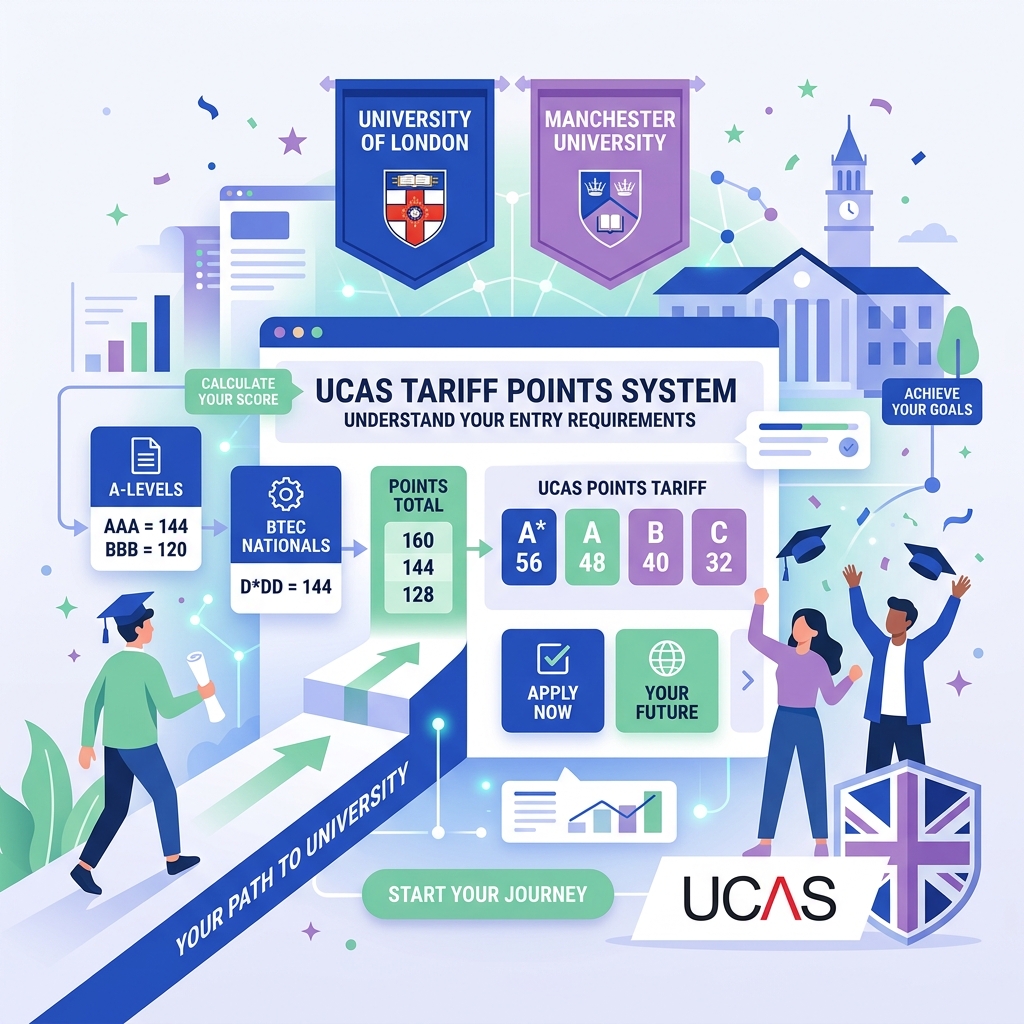
You just found your dream course at a UK university. The entry requirement says "112 UCAS points." You stare at your A-Level results — an A, a B, and a C — and have absolutely no idea if that is enough. The problem with raw grades is they do not speak the same language as university admissions. UCAS tariff points are the universal translator. But let's look at the numbers.
The Instant Answer: Calculate Your UCAS Points
The math is actually pretty simple. Each qualification grade maps to a fixed number of tariff points. You add them up. That is it.
What Are UCAS Tariff Points?
UCAS tariff points are a standardized scoring system used across the UK to compare different qualifications on a single scale. Not every university uses them — some specify exact grades instead — but for the ones that do, tariff points are the currency of admission.
Think of it this way: an A-Level A grade and a BTEC Distinction are completely different qualifications. Without tariff points, a university cannot meaningfully compare them. The tariff system collapses everything into one number.
The Key Principle
Higher grade + bigger qualification size = more points.
An A at A-Level is worth more than an A at AS-Level because A-Levels carry more study hours. A Distinction in a 180-credit BTEC obliterates a Merit in a 90-credit BTEC. Size matters.
A-Level to UCAS Points Conversion Table
This is the table that matters most. Print it. Screenshot it. Tattoo it on your forearm before results day.
A-Level Grade → UCAS Tariff Points
| A-Level Grade | UCAS Points | AS-Level Equivalent |
|---|---|---|
| A* | 56 | — |
| A | 48 | 20 |
| B | 40 | 16 |
| C | 32 | 12 |
| D | 24 | 8 |
| E | 16 | 4 |
Quick Calculation
Three A-Levels at grades A, B, C:
- A = 48 points
- B = 40 points
- C = 32 points
- Total = 120 UCAS points
Use the UCAS Tariff Points Calculator to convert your exact combination instantly.
BTEC Qualifications and UCAS Points
BTECs are not second-class qualifications. A Level 3 BTEC Extended Diploma (the big one — 180 credits) can be worth as much as three A-Levels in tariff points. The mapping is different, but the currency is the same.
BTEC Level 3 → UCAS Tariff Points
| BTEC Grade | Extended Diploma (180 glh) | Diploma (120 glh) |
|---|---|---|
| DDD* | 168 | 112 |
| DDD | 160 | 104 |
| D*DD | 152 | 96 |
| DDD | 144 | 96 |
| MMM | 96 | 64 |
| PPP | 48 | 32 |
A BTEC Extended Diploma at DDD gives you 144 points — more than three A-Levels at ABB (128). Do not let anyone tell you BTECs cannot compete.
T-Levels: The New Player
T-Levels are the UK government's newest technical qualification, launched in 2020. Each T-Level is worth a single number:
A single T-Level at Distinction is equivalent to three A-Levels at AAA. That is not a typo. One qualification, one exam series, same tariff weight.
How Universities Actually Use Tariff Points
Here is the reality. Not every university uses tariff points the same way:
| Approach | What It Means | Example | |----------|--------------|---------| | Tariff-only | Points are the sole entry metric | "120 UCAS points required" | | Tariff + subject condition | Points plus specific subject grades | "112 points including B in Maths" | | Grade-only | No tariff — exact grades specified | "AAB at A-Level" | | Contextual offer | Lower tariff for disadvantaged applicants | "96 points (contextual)" |
Pro Tip — The Trench Truth: Meeting the tariff requirement does not guarantee an offer. Competitive courses at top universities receive thousands of applications that all meet the points threshold. Your personal statement, references, and sometimes admissions tests are the actual differentiators. Treat tariff points as the minimum entry ticket, not the winning formula.
Mixing Qualifications
You can combine different qualification types to reach your tariff target. A common mix:
- A-Level A (48) + A-Level B (40) + BTEC Subsidiary Diploma Distinction (48) = 136 points
UCAS has a full tariff calculator on their website, but for quick calculations, use our UCAS Tariff Points Calculator.
What Counts (And What Does Not)
- ✅ A-Levels, AS-Levels, BTECs, T-Levels, Scottish Highers, International Baccalaureate, Welsh Baccalaureate, Core Maths, EPQ
- ❌ GCSEs (not counted in tariff for university entry)
- ❌ Duplicate qualifications in the same subject (you cannot count both an A-Level and a BTEC in Business if they cover the same content)
The Step-by-Step Calculation Flow
Common Target Scores
Most undergraduate courses in the UK fall into these tariff bands:
Typical UCAS Requirements by University Tier
| University Tier | Typical Tariff | A-Level Equivalent |
|---|---|---|
| Russell Group (competitive) | 128–152 | A*AA – AAB |
| Russell Group (standard) | 112–128 | ABB – BBB |
| Post-1992 universities | 96–112 | BCC – CCC |
| Foundation / Access courses | 48–80 | DD – DDE |
Frequently Asked Questions
Need to convert your exact grades into UCAS points? Use our UCAS Tariff Points Calculator for an instant, accurate result. For broader grade conversions across international systems, try the GPA to Percentage Converter or the ECTS Grade Converter.
Discussion
Loading comments...