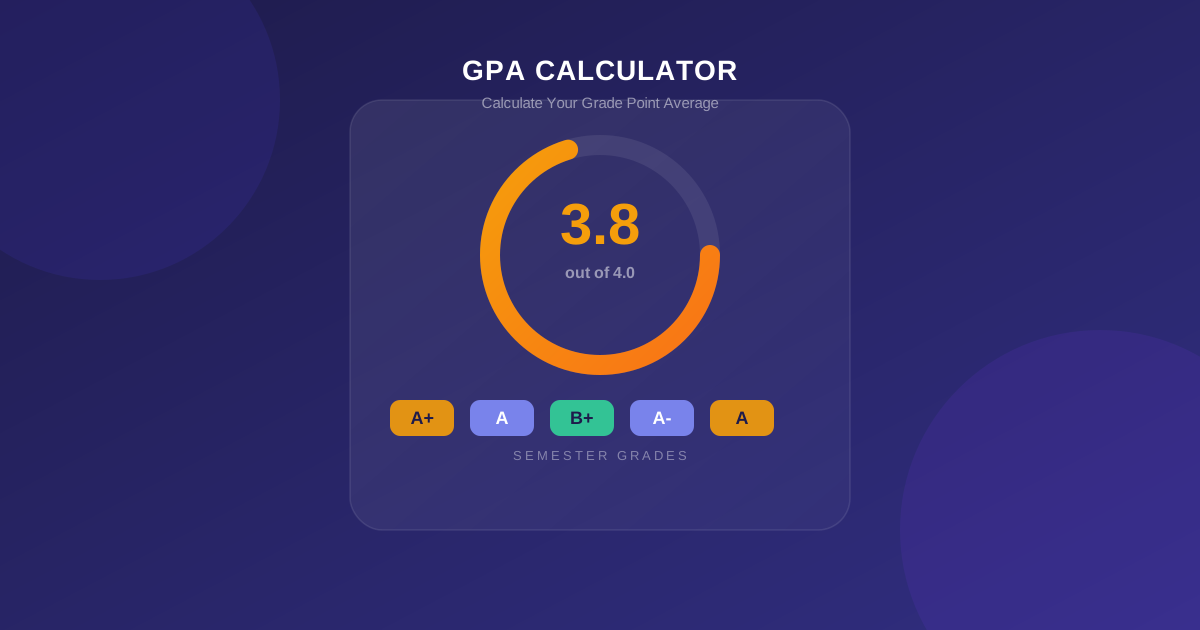
You open your final report card and stare at a confusing jumble of letters and credit numbers. Your heart does a nervous flip because your scholarship or graduation hinges on that single, all-important number, but the GPA math feels like an absolute black box. Don't panic. The math behind your GPA is actually a simple weighted average, and we can calculate your exact score in just three steps.
The Core GPA Formula
To calculate your Grade Point Average, you need two values: the credit hours for each course and the numerical point value of the letter grade you earned.
GPA = Total Quality Points ÷ Total Credits Attempted
No shortcuts, no exceptions — you must find your total quality points before you can divide by your credits.
Use the interactive tool below to check your individual course grade percentages and convert them to point scales:
Step 1: Convert Letter Grades to Grade Points
Before doing any math, you must translate your letter grades (A, B, C) into numbers. Most high schools and universities in the United States operate on a standard 4.0 scale.
Here is the standard grade point mapping:
| Letter Grade | Percentage Range | Standard Grade Points | | :--- | :--- | :--- | | A | 93–100 | 4.0 | | A- | 90–92 | 3.7 | | B+ | 87–89 | 3.3 | | B | 83–86 | 3.0 | | B- | 80–82 | 2.7 | | C+ | 77–79 | 2.3 | | C | 73–76 | 2.0 | | D | 60–69 | 1.0 | | F | Below 60 | 0.0 |
To learn more about how international grading scales match this mapping, check out our guide on the US Grading System.
Step 2: Multiply Grade Points by Course Credits
Each course has a credit weight (usually 3 or 4 credits for lectures, and 1 credit for labs). To calculate Quality Points (also called honor points), multiply the grade points you earned by the course credits.
For example, if you earned an A (4.0 points) in a 4-credit Chemistry lecture:
- 4.0 Grade Points × 4 Credits = 16.0 Quality Points
If you earned a C (2.0 points) in a 1-credit Chemistry lab:
- 2.0 Grade Points × 1 Credit = 2.0 Quality Points
Step 3: Sum the Points and Divide by Total Credits
The biggest mistake students make is adding their course GPAs directly and dividing by the number of classes (e.g., averaging 4.0 and 2.0 to get 3.0). Ignoring credit weights is the absolute biggest killer of GPA calculations.
A bad grade in a heavy 4-credit lecture drags your GPA down four times harder than a bad grade in a 1-credit seminar.
Let's look at a real semester example to see how this works:
| Course | Letter Grade | Grade Points | Credit Hours | Quality Points | | :--- | :---: | :---: | :---: | :---: | | Chemistry Lecture | A | 4.0 | 4 | 16.0 | | Chemistry Lab | C | 2.0 | 1 | 2.0 | | Calculus I | B | 3.0 | 4 | 12.0 | | History 101 | A- | 3.7 | 3 | 11.1 | | Totals | - | - | 12 | 41.1 |
Now, we apply the core formula:
- 41.1 Quality Points ÷ 12 Credit Hours = 3.425 GPA
If you had ignored weights and simply averaged the grade points (4.0 + 2.0 + 3.0 + 3.7) ÷ 4, you would get 3.175 — a significant understatement of your actual academic standing.
The Trench Truth — The Retake Trap: Standard online GPA calculators completely fall apart when it comes to retakes and grade forgiveness. If you are retaking a class you got an F in last semester, a basic calculator will simply add the new grade to the pile. In reality, most institutional policies at schools like the University of Michigan will either completely replace the old grade or average the two. Always use a dedicated Weighted Grade Calculator that allows you to adjust weights, and check your specific university registrar rules so your cumulative calculations are not wildly off.
Frequently Asked Questions
Take Control of Your Academic Metrics
If you are tracking multiple subjects and want to find your overall grade performance, use our Average Marks Calculator to quickly sum and divide your grades. For calculating what you need on upcoming assignments to maintain your standing, check out our Marks Needed Calculator.
Discussion
Loading comments...