You are sitting with an A in homework and participation but a B overall in your course portal. Confused and stressed, you realize your syllabus has hidden weights where a single bad final exam grade can completely destroy your hard work. Don't panic. Calculating a weighted average is simple once you learn how to multiply grades by their percentage weights and sum them up.
The Weighted Average Formula
Unlike a simple average where every assignment has the same impact, a weighted average assigns more importance to specific categories (like midterms or projects) as explained by the Wolfram MathWorld Weighted Mean Guide.
Weighted Average = Sum of (Score × Weight) ÷ Sum of Weights
Note: If your category weights add up to 100% (or 1.0 in decimal form), the formula simplifies to: Sum of (Score × Weight).
Use the interactive calculator below to quickly sum your course categories and verify your grades:
Step-by-Step Weighted Grade Calculation
To compute your current weighted standing, follow these three steps:
- Multiply each category score by its respective decimal weight (e.g., 85% score × 25% weight = 21.25).
- Add all these weighted values together to get your total weighted sum.
- Divide by the total weight of the completed assignments (usually 100% or 1.0).
Let's look at a typical course breakdown:
- Homework (20% weight): Score of 95%
- Quizzes (30% weight): Score of 88%
- Final Exam (50% weight): Score of 74%
Applying the math:
- Homework: 95 × 0.20 = 19.0
- Quizzes: 88 × 0.30 = 26.4
- Final Exam: 74 × 0.50 = 37.0
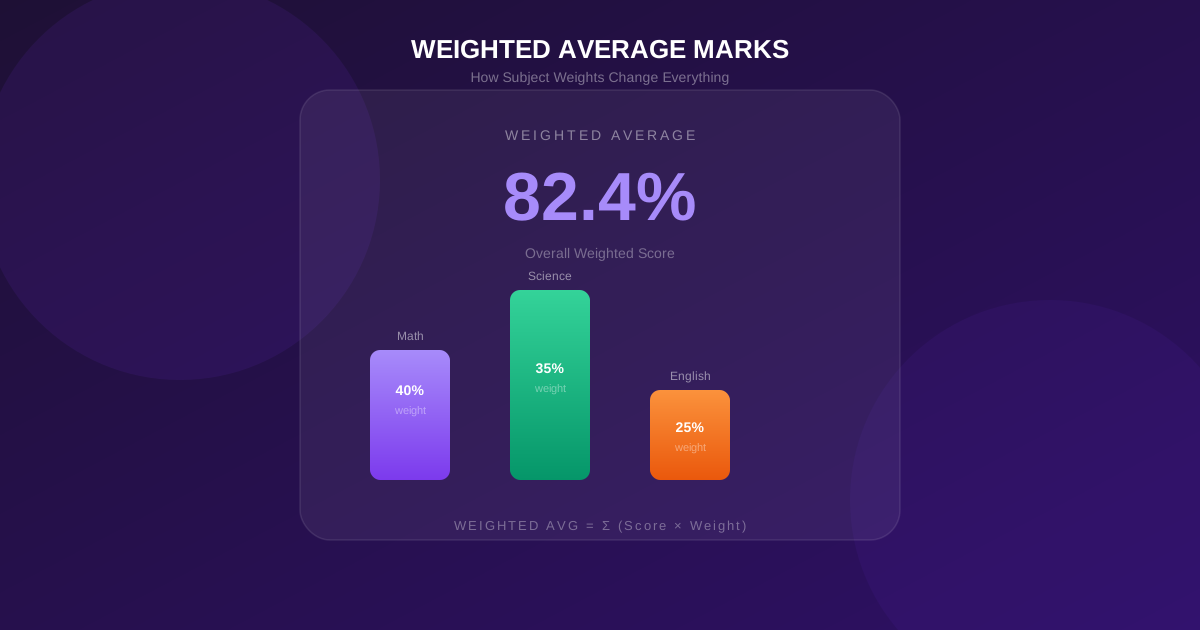
- Weighted Average: 19.0 + 26.4 + 37.0 = 82.4%
Even though your final exam score was a C, your high homework and quiz grades pulled your overall class standing to a comfortable B. For details on how to average simple lists of marks, read our guide on [How to Calculate Average Marks for 5 Subjects](/blog/how-to-calculate-average-marks-for-5-subjects).
The Trench Truth — The Syllabus Traps: Professors love to hide weights inside conditional rules in the syllabus. A footnote might state: "Quizzes are 20%, but your lowest quiz is dropped only if you maintain a 90% attendance rate." Or worse: "You must pass the final exam to pass the course, regardless of your weighted average." Students calculate a mathematically safe 82% going into the final, bomb the final with a 55%, and are shocked when they fail the entire course. Always review the fine print, and check your attendance standings using our Attendance Planner.
The Mid-Semester Projection: The "Scale to 100" Shortcut
If it is mid-semester and only 40% of the total course weight has been graded, do not calculate your grade out of 100%.
Instead, use the Scale to 100 shortcut to treat your completed work as its own miniature semester:
Running Average = (Points Earned So Far ÷ Available Weight) × 100
For example, if you have earned 32 points out of that completed 40% weight:
- (32 ÷ 40) × 100 = 80.0% running average
This gives you a realistic projection of your current standing. If you are aiming for a specific target grade, use our Marks Needed Calculator to see what scores you need on the remaining 60% of the course weight.
For mapping these course results to college transcripts, review our GPA Calculator Guide.
Academic rules and grading standards vary, but Yale University maintains an excellent summary of weighted grading structures on the Yale Registrar Services Page, as does the grading guidelines at Carnegie Mellon University.
Frequently Asked Questions
Master Your Grade Calculations
If you need to verify your math or convert your averages into standard grades, use our Weighted Grade Calculator. For calculating simple averages, use the Average Marks Calculator. If you are preparing for international applications, check out our GPA to Percentage Calculator.
Discussion
Loading comments...