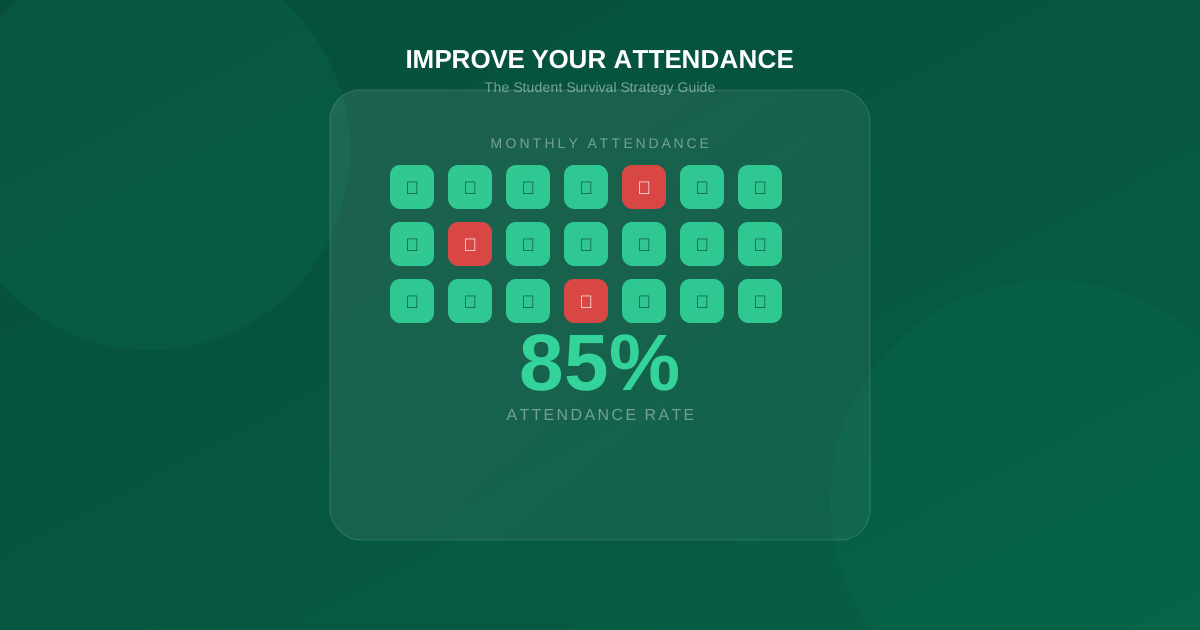
You log into your student portal, check your attendance, and freeze: you are sitting at 72% with a strict 75% or 80% syllabus policy. Panic sets in as you realize a single automatic grade deduction could tank your hard work, and generic advice like "just go to class" feels completely useless. Relax. You can recover your standing by understanding the exact math of attendance recovery and proposing a proactive contract to your professor.
The Attendance Recovery Formula
To improve your attendance percentage, you need to know exactly how many consecutive classes you must attend to cross the syllabus threshold.
Classes to Attend = (Target% × Total Classes - Attended Classes) ÷ (1 - Target%)
Note: In this formula, percentages are represented as decimals (e.g., 75% is 0.75).
Let's calculate your current numbers. Use the interactive calculator below to find your starting point:
Step-by-Step Attendance Audit
Before negotiating with a professor, you must perform a cold, hard review of your academic calendar.
- Count the remaining classes: Look at your syllabus to see how many sessions are left in the semester.
- Identify your target threshold: Find the exact percentage required to avoid a grade penalty (typically 75% or 80%).
- Run the recovery math: Verify if achieving that percentage is mathematically possible given the remaining sessions.
For instance, if your class meets 30 times in a semester, and you have attended 15 out of the first 22 sessions (68.1%):
- To reach a 75% target (which requires 22.5, rounded up to 23 present sessions):
- You must attend 8 out of the 8 remaining classes to finish with 23/30 sessions (76.6%).
- If you miss even one more session, you will finish at 22/30 (73.3%) and face the penalty.
Knowing these numbers keeps you from guessing where you stand. For tracking multiple components of your course evaluation, check out our guide on how to calculate Weighted Average Marks.
The Trench Truth — The Proactive Contract: When you are hovering at a low percentage, sending a late email saying "I was sick, can I be excused?" is a waste of time. Instead, show up to office hours and present a proactive contract. Say: "I know my attendance is at 72%. I've had some personal hurdles, but I am committed to finishing strong. If I promise 100% attendance for the remaining 4 weeks, sit in the front row, and submit a 1-page summary of every lecture, will you waive the automatic grade deduction?" Professors hate excuse-making, but they appreciate students who make their grading lives easier by proposing a concrete solution.
The Syllabus Loophole Appeal
If you have already crossed the line and are facing failure, do not give up. Many university boards, including student support policies at Columbia University Student Affairs, advocate for clear syllabus terms. According to research on student attendance patterns from the Brookings Institution, consistent school attendance is one of the strongest predictors of final course grades and graduation rates, which is why institutions enforce these strict thresholds.
The most successful attendance appeals usually involve finding ambiguous wording around "excused" vs. "unexcused" absences or the definition of a "class session."
For example, a professor might try to fail you for missing three lectures under a strict "3 absences max" policy. However, if the syllabus states that "participation in weekly discussions is required," and the professor combined a 50-minute lecture and a 50-minute lab into a single "day" in their gradebook, you have a solid case.
Technically, you only missed 1.5 weeks of actual content, not 3 distinct weeks. Combined with a retroactive medical note from your university's health center, department chairs will often override a professor's grading system and allow makeup work.
Frequently Asked Questions
Keep Your Grades Stable
If your attendance issues have affected your test scores, use our Average Marks Calculator to see where your grades stand. If you need to make up ground on your final exams, use the Marks Needed Calculator to determine the exact score you need. For students mapping out their overall GPA, we recommend our comprehensive GPA Calculator.
Discussion
Loading comments...