You just got accepted into an Erasmus+ exchange program. Your home university grades you on a 10-point Dutch scale. Your host university in Spain uses a 0–10 system too — but the thresholds are completely different. A 7 in the Netherlands is a solid "good." A 7 in Spain is barely passing. You are about to spend a semester abroad with two grading systems that do not speak the same language. ECTS is the translator. But let's look at the numbers.
The Instant Answer: Convert Your Grade to ECTS
The math is actually pretty simple. ECTS does not use its own numeric scale. It uses a percentage-based ranking system that places your grade relative to your peers. Plug your grades into the tool below to see where you land.
What Is ECTS?
The European Credit Transfer and Accumulation System (ECTS) is the standard framework adopted by the European Higher Education Area (EHEA) to make grades comparable across 48 countries. It was introduced in 1989 as part of the Erasmus mobility program and has since become the backbone of academic recognition across Europe.
ECTS does two things:
- Standardizes credit workload — 1 ECTS credit = 25–30 hours of student work (lectures, self-study, exams). A full academic year = 60 ECTS credits.
- Normalizes grades — The ECTS grading scale ranks your performance against your cohort, not against an absolute percentage.
The second part is where most students get confused. Here is the reality.
The ECTS Grading Scale
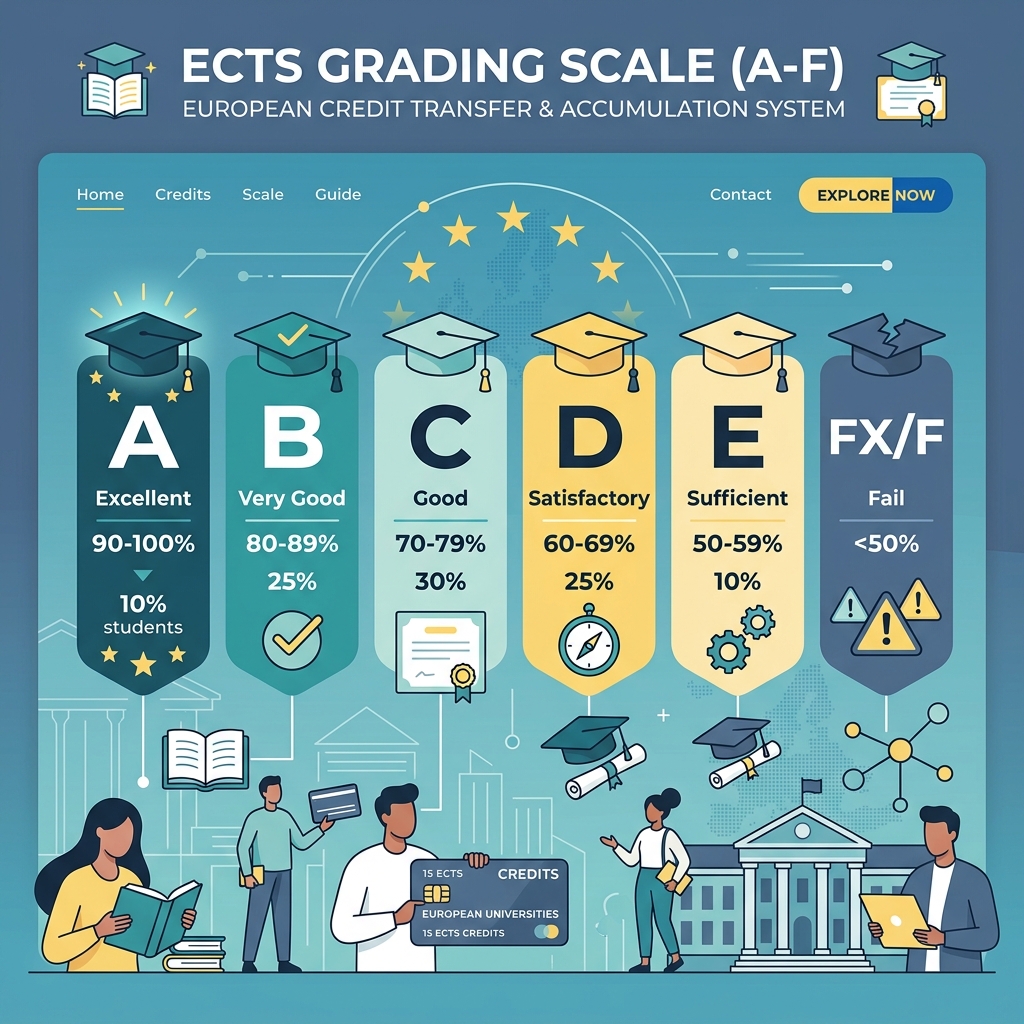
ECTS uses a relative grading system. Your grade is defined by what percentage of students in your cohort scored the same or lower than you. It is a percentile ranking, not a raw score conversion.
The Official ECTS Grading Scale
| ECTS Grade | Meaning | Percentile | Definition |
|---|---|---|---|
| A | Excellent | Top 10% | Outstanding performance with only minor errors |
| B | Very Good | Next 25% | Above average with some errors |
| C | Good | Next 30% | Sound and acceptable work |
| D | Satisfactory | Next 25% | Fair but with significant shortcomings |
| E | Sufficient | Bottom 10% | Meets minimum requirements |
The Visual Breakdown
Notice: 35% of students get an A or B. This is not a curve where only 5% can excel. ECTS assumes that in a well-functioning program, a significant chunk of students perform above average.
Pro Tip — The Trench Truth: Most European universities do not actually use ECTS grades on transcripts. They use their own national scales and include a separate "ECTS grade" column only for exchange students. When you see a Dutch 8 or a Spanish 9, that is the local grade. The ECTS equivalent is derived separately by comparing the student's position within the statistical distribution of that cohort. If your university does not publish cohort statistics, the ECTS conversion is an approximation — not an exact science.
How Different Countries Map to ECTS
This is where things get messy. Every country has its own scale, and the same numeric score means completely different things depending on where you are.
National Grade → ECTS Equivalent (Approximate)
| ECTS | Germany (1–5) | Netherlands (1–10) | Spain (0–10) | France (0–20) |
|---|---|---|---|---|
| A | 1.0–1.5 | 9.5–10 | 9–10 | 16–20 |
| B | 1.6–2.5 | 8.0–9.4 | 7–8.9 | 14–15.9 |
| C | 2.6–3.5 | 7.0–7.9 | 6–6.9 | 12–13.9 |
| D | 3.6–4.0 | 6.0–6.9 | 5–5.9 | 10–11.9 |
| E | 4.0 (bestehend) | 5.5–5.9 | 5 (aprobado) | 10 (passable) |
The critical trap: a Dutch 7 and a Spanish 7 are NOT the same ECTS grade. In the Netherlands, a 7 is "Good" (ECTS C). In Spain, a 7 is "Notable" (ECTS B). The number is identical. The meaning is completely different.
Use the ECTS Grade Converter to map your local grades accurately.
ECTS Credits: The Workload Framework
Grades are only half the system. ECTS credits measure how much work a course requires. The standard:
1 ECTS credit = 25–30 hours of total student workload
This includes lectures, seminars, lab work, independent study, assignments, and exam preparation. A full academic year is 60 ECTS credits, which translates to roughly 1,500–1,800 hours of work.
Typical Degree Structure
ECTS Credits by Degree Level
| Degree | Total ECTS | Duration | Workload (hours) |
|---|---|---|---|
| Bachelor's | 180–240 | 3–4 years | 4,500–7,200 |
| Master's | 60–120 | 1–2 years | 1,500–3,600 |
| PhD | 180–240* | 3–4 years | Not standardized |
* PhD credits are not regulated by ECTS in most countries. The numbers shown are typical for structured doctoral programs.
The Step-by-Step Conversion Process
Why ECTS Matters for Erasmus+ Students
If you are going on exchange, ECTS is not optional — it is the mechanism that ensures your grades abroad count toward your degree at home. Without proper ECTS conversion:
- Your host university grades might not transfer
- You could lose a semester of academic progress
- Your GPA calculation at home could be wrong
The European Commission requires all Erasmus+ participants to receive a transcript of records with both local grades and ECTS equivalents. If your host university does not provide this, request it before you leave.
ECTS vs US GPA: A Quick Comparison
ECTS vs US GPA at a Glance
| Feature | ECTS | US GPA |
|---|---|---|
| Scale | A–E (5 letters) | 0.0–4.0 (numeric) |
| Grading logic | Relative (percentile) | Absolute (percentage-based) |
| Credit unit | ECTS credit (25–30 hrs) | Credit hour (1 hr/week) |
| Full year | 60 ECTS | 30 credit hours |
| Region | 48 EHEA countries | United States |
For converting between these systems, use the GPA to Percentage Converter alongside the ECTS Grade Converter.
Frequently Asked Questions
Need to convert your grades to the ECTS scale? Use our ECTS Grade Converter for an instant mapping. For broader international grade comparisons, try the GPA to Percentage Converter or the Weighted Grade Calculator.
Discussion
Loading comments...