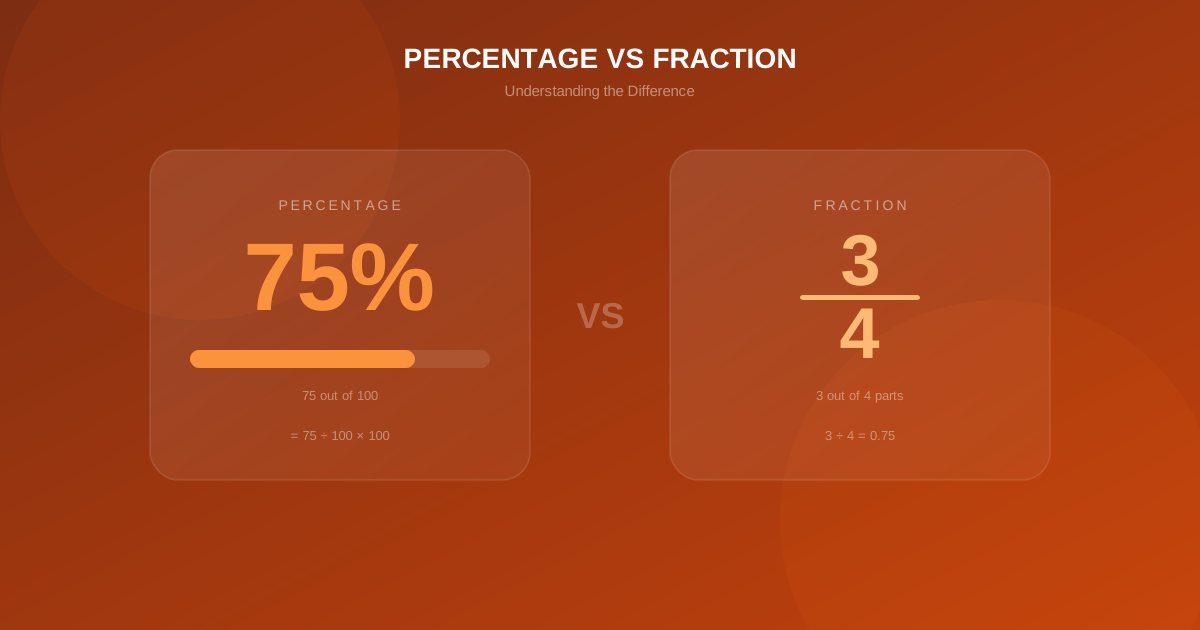
You look at a quiz grade written as 5/8 and draw a blank on whether to celebrate or start studying. Raw fractions represent performance, but they are hard to visualize compared to other scores, leaving you anxious and unable to rank your standing. Don't worry. Converting fractions to percentages normalizes the denominator to 100, letting your brain instantly see exactly how you performed.
The Core Difference
Fractions and percentages are both ways of representing parts of a whole, but they represent them differently as defined in Britannica's Math Index.
- Fractions represent a raw relationship of parts to a whole (e.g., 5 parts out of 8). They feel like a performance score on a specific assignment.
- Percentages normalize that relationship to a base of 100 (e.g., 62.5%). They feel like a status or rank.
Use the tool below to convert any fraction score into an aggregate percentage:
The Pizza Slice Analogy
To understand why our brains prefer percentages, think of a pizza.
If you eat 5 out of 8 slices of a pizza, it is difficult to visualize how much you ate compared to a friend who ate 7 out of 11 slices. Your brain struggles to compare fractions with different denominators.
But if we convert those scores to percentages:
- You ate 62.5% of your pizza.
- Your friend ate 63.6% of their pizza.
Percentages normalize the denominator to 100, enabling your brain to instantly rank the values. You immediately see that your friend ate slightly more, and you both ate more than half (50%) but less than three-quarters (75%).
For academic grading, this normalization is crucial. Learn more about aggregate markings in our guide on How to Calculate Marks Percentage from Total Marks.
How to Convert a Fraction to a Percentage
The conversion formula is straightforward:
Percentage (%) = (Numerator ÷ Denominator) × 100
- Divide the top number (numerator) by the bottom number (denominator) to get a decimal.
- Multiply the decimal by 100 to convert it to a percentage.
For example, to convert 13/20:
- Step 1: 13 ÷ 20 = 0.65
- Step 2: 0.65 × 100 = 65%
If you want to automate this process in spreadsheets, read our tutorial on How to Calculate Percentage in Excel.
How to Convert a Percentage to a Fraction
Converting in the opposite direction requires division and simplification:
- Write the percentage over a denominator of 100 (e.g., 45% becomes 45/100).
- Simplify the fraction by dividing the top and bottom by their greatest common divisor (GCD).
For example, to convert 45%:
- Step 1: Write as 45/100.
- Step 2: Divide both by 5 to get 9/20.
The Trench Truth — The Tiny Quiz Panic: The worst student anxiety happens with small-total assignments (like a quiz worth 7 points). If you get a 5/7, it doesn't sound terrible. But when the online portal converts that to a 71.4% (C-), you might panic. You feel like you are failing, forgetting that losing just two points on a tiny assignment should not carry the emotional weight of a C- on a midterm. Keep perspective on your Weighted Average Marks.
Common Conversion Table
| Fraction | Decimal | Percentage | | :--- | :--- | :--- | | 1/2 | 0.50 | 50.0% | | 1/3 | 0.333 | 33.3% | | 1/4 | 0.25 | 25.0% | | 3/4 | 0.75 | 75.0% | | 1/5 | 0.20 | 20.0% | | 3/5 | 0.60 | 60.0% | | 1/8 | 0.125 | 12.5% | | 5/8 | 0.625 | 62.5% |
For more conversion patterns, visit Khan Academy Math Resources or check mathematical formulas on Wolfram MathWorld.
Frequently Asked Questions
Manage Your Math Metrics
Struggling to keep track of your scores? Use our Marks to Percentage Calculator to convert any fractional grade instantly. If you need to plan your grades to hit a target, use the Marks Needed Calculator. For broader academic planning, check out our GPA Calculator and Attendance Planner.
Discussion
Loading comments...